Panic Bars and Fire Exit Locks: What the Law Requires and How to Keep Exits Secure
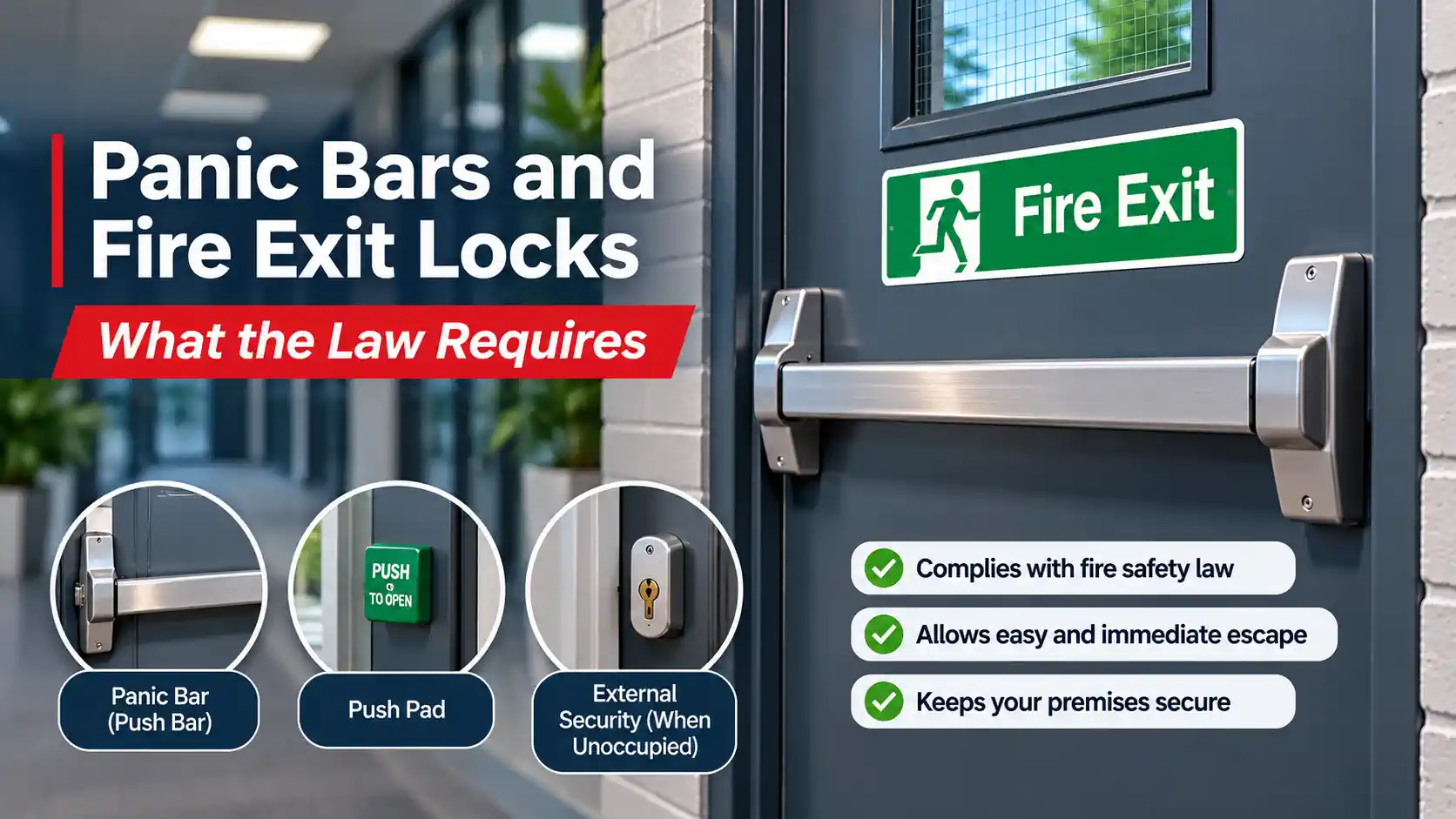
A panic bar is a horizontal push bar on an escape door that releases the latch when anyone pushes it, with no key, code or prior knowledge needed. In England, article 14 of the Regulatory Reform (Fire Safety) Order 2005 says emergency doors must not be locked or fastened so that they cannot be easily and immediately opened by anyone who may need them in an emergency. You can secure a fire exit, but never in a way that stops it opening from the inside while people are in the building.
This is general information, not legal advice. For your own premises, your fire risk assessment and the fire service are the authorities.
Can fire exit doors be locked?
Not while the premises are occupied, if the lock stops the door opening easily and immediately. Article 14 also says:
- routes to emergency exits, and the exits themselves, must be kept clear at all times;
- emergency doors must open in the direction of escape;
- sliding or revolving doors must not be used for exits specifically intended as emergency exits.
There is one narrow allowance for night security. Approved Document B, Volume 2, the building regulations guidance for buildings other than dwellings in England, says some final exit doors may have security locks that are used only when the building is empty, backed by management procedures. The GOV.UK guide for offices and shops goes further: staff should be instructed in removing additional security, bolts, bars or chains on final exit doors before the start of business.
Who is the responsible person?
The Order puts the duty on the “responsible person”. Under article 3, that is the employer, if the workplace is to any extent under their control. Otherwise it is the person who has control of the premises in connection with a business or other undertaking, or the owner where that person does not have control.
The responsible person must make a suitable and sufficient fire risk assessment and keep a record of it (article 9). Essex County Fire and Rescue Service is clear that a fire risk assessment is a legal requirement, and that if you cannot do one yourself you must appoint a specialist. Failing in these duties where it puts people at risk of death or serious injury is an offence. On conviction in the Crown Court the penalty can be a fine, up to two years’ imprisonment, or both (article 32).
Panic bar or push pad? BS EN 1125 and BS EN 179
The Order does not name a product. It sets the outcome, and two standards describe hardware for two situations.
- BS EN 1125 covers panic exit devices operated by a horizontal bar, meaning push bars and touch bars. BSI lists BS EN 1125:2008 as current and under review. The Door & Hardware Federation’s best practice guide says the emphasis of this standard is on safe exit rather than security.
- BS EN 179 covers emergency exit devices operated by a lever handle or push pad. The Door & Hardware Federation says these should only be used where occupants are familiar with the emergency exit and its hardware.
The GOV.UK offices and shops guide draws the same line: where members of the public, or others who do not know the building, are present, use panic exit bar devices to BS EN 1125. Premises with limited numbers of staff who know the building, where panic is not likely, may use push pads or lever handles to BS EN 179.
| Who uses the door | Usual choice | Why |
|---|---|---|
| Customers or visitors: shop floor, café, pub, waiting room | Panic bar or touch bar (BS EN 1125) | Members of the public may not know the building or the door |
| A room in a shop, commercial building or place of assembly that holds more than 60 people (new building work) | No lock, latch or bolt, or a BS EN 1125 panic fastening | Approved Document B, paragraph 5.9 |
| Staff-only stockroom or office exit, small trained team, panic unlikely | Push pad or lever handle (BS EN 179) | Occupants know the exit and its hardware |
| Not sure who will use it, for example seasonal temporary staff | BS EN 1125 | The Door & Hardware Federation recommends BS EN 1125 where there is any doubt |
Where more than 60 people might be expected to use a door during a fire, Approved Document B says it should always open in the direction of escape.
How to keep a fire exit secure without breaking the law
Most of the rules below are about what gets added to, or wired into, a compliant door. Work through them in order.
- Remove add-ons before opening. Padlocks, hasps, chains, drop bars and extra bolts must come off before anyone is in the building. The GOV.UK guide lists removing bolts, padlocks and security devices from fire exits as a daily check.
- Keep night security to an empty building. If a final exit has a security lock for out-of-hours use, it should be used only when the building is empty, with a written procedure naming who removes it before opening.
- Check electric locks fail safe. Approved Document B says electrically powered locks should release on three triggers: the fire alarm operating, loss of power or a system error, and a security override being activated. The override should be a Type A call point as described in BS 7273-4, on the side people escape from. In public areas, the GOV.UK guide says pushing the bar should release an electromagnetic lock immediately.
- Keypads and card readers need an override. Where a secure door works by code, card or biometrics, Approved Document B says an override should be possible from the side approached by people escaping.
- Be wary of time delays and hold-backs. Time-delay devices are not usually acceptable for members of the public. Dogging or hold-back features cannot be used on fire doors unless the door and hardware were tested in the unlatched condition.
- Use only tested parts. The Door & Hardware Federation says panic and emergency devices should be supplied complete, or the manufacturer must list the tested compatible components and accessories. Parts from a different range have not been tested with that device.
- Sign it. The GOV.UK guide says a “Push bar to open” notice should sit immediately above the bar on doors with a panic bolt or latch, and a fire escape keep clear notice should sit at about eye level on the outside face of escape doors.
If staff keep chaining or propping a door because it feels insecure, review the hardware and procedure together rather than adding another lock.
Pre-Christmas fire exit checklist
In December, extra stock and new seasonal staff are both worth planning for. This checklist is built from the GOV.UK example maintenance checklist and the points above.
| When | Check |
|---|---|
| Every morning, before opening | All bolts, padlocks and chains removed. Every fire exit opens immediately and easily from the inside. Escape routes and the area around each exit are clear of stock, cages and deliveries. Doors swing freely and close fully. |
| Weekly | Push bars and push pads work correctly. External routes beyond each exit are clear and safe. |
| Monthly | Electronic release mechanisms work and fail safe in the open position. Automatic doors on escape routes fail safe open. Self-closers and fire door seals are in good condition. |
| Before temporary staff start | Show each person every exit, how its device works, and which security must come off before opening. |
| When the layout changes | Review and update the fire risk assessment. Essex County Fire and Rescue Service offers a risk assessment template and a fire safety log book. |
Practical signs that the hardware needs attention: the bar has to be pushed hard or twice, the door does not re-latch when it closes, the vertical rods catch on the floor or frame, or the door drops and binds on the threshold.
Frequently asked questions
Does the law say I must fit a panic bar?
Not in those words. The Fire Safety Order requires emergency doors to open easily and immediately. Guidance for new building work and the GOV.UK risk assessment guides point to BS EN 1125 panic bars where members of the public use the exit, or where more than 60 people use a room in shops, commercial buildings and places of assembly. Your fire risk assessment should settle it for your premises.
How often should panic bars be checked?
The GOV.UK example checklist asks whether fire exits open immediately and easily every day, and whether push bars and pads work correctly every week. Record the checks, so you can show them to the fire service if asked.
Need a hand with the locks around your exits?
A fire risk assessor or the fire service decides what your exits need. Parade Locks looks after the lock side for shops, offices, schools and landlords across Clacton, Colchester and the surrounding Tendring and north Essex area, from commercial lock repairs and replacements to security surveys and master key systems that control who can reach back doors and stockrooms. Parade Locks takes emergency call-outs 24 hours a day, and Parade Locks does not charge a call-out fee. Call 07889 977737 or send a message to book a lock and security check.