Patio Door Security: How to Stop Sliding and French Doors Being Forced
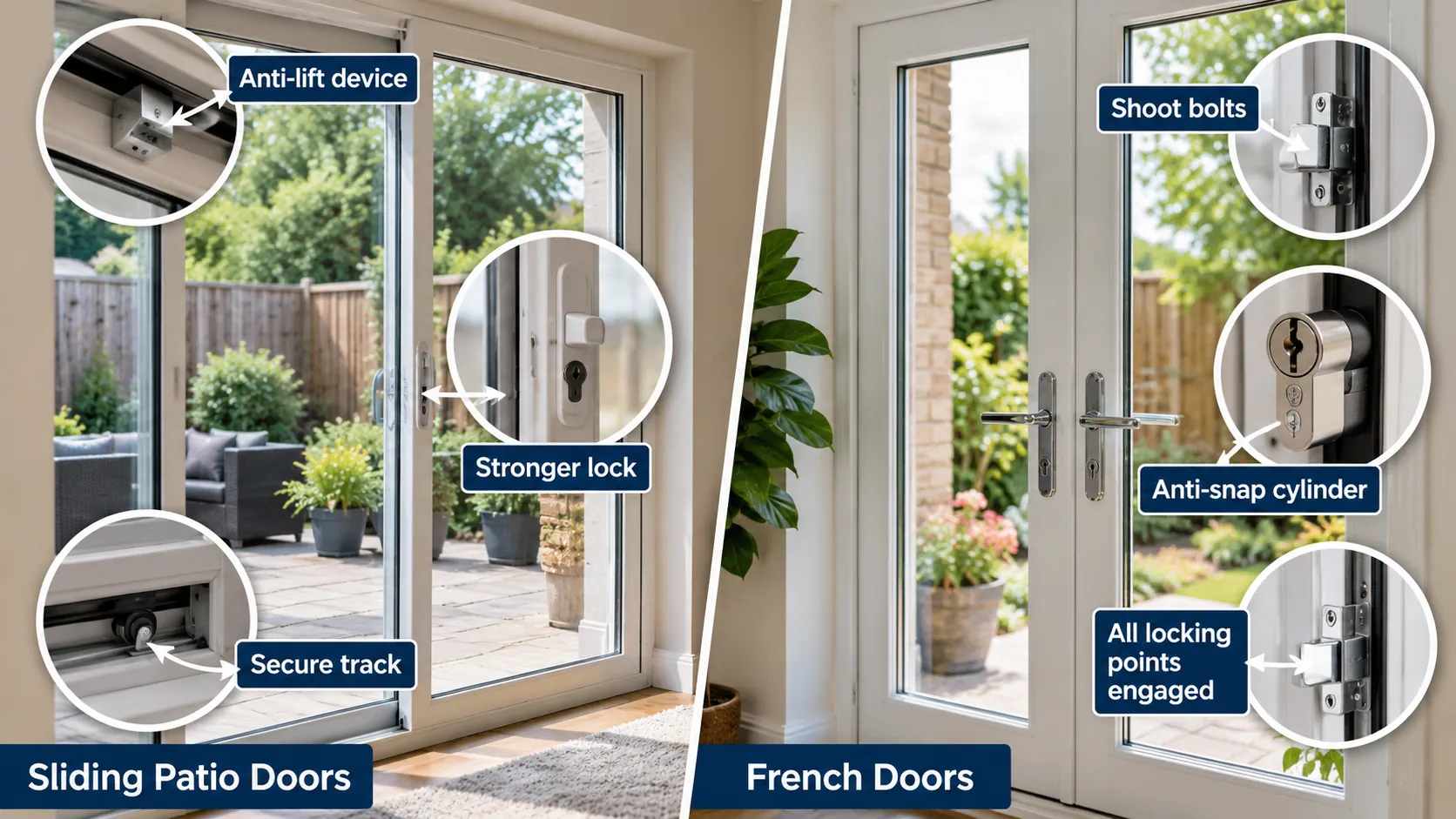
Good patio door security comes down to three checks. Can the door be lifted or pushed out of its frame, does every locking point actually engage, and can the cylinder be snapped from outside? Sliding doors usually fail on the first, French doors on the second, and both share the third. The fixes below start with free habits and work up to lock upgrades, so you can make a start tonight.
Patio doors are often at the back of the house, out of sight of the street, and that matters more once the clocks go back on Sunday 25 October 2026. At the launch of its autumn and winter crime prevention campaign, Essex Police Assistant Chief Constable Andy Prophet said: “As clocks go back and mornings and early evenings get darker, we do see increases in some crime types.” (Essex PFCC)
Where sliding patio doors are weak
Lifting the panel off its track
A sliding panel runs on rollers in a bottom track and is held in place by a top track. If there is enough clearance above the panel, it can be levered up and out of the frame while the lock is still locked. That is why police advice is to check your sliding door has an anti-lift device fitted so it cannot be lifted out of the frame. On an older door, West Yorkshire Police suggests a timber batten fixed into the top track to limit the space a panel can be lifted into.
Hooks that only just catch
Many uPVC sliding doors lock with hooks that swing into a keep on the frame. Essex Police describes these multi-locking doors as using a system of hooks and latches. If the panel has dropped on its rollers or the keep has worked loose, the hooks may only catch the edge. With the door locked, push and pull the panel firmly along its run. It should not move. If it rattles or shifts, the hooks are not seating properly.
Bars in the bottom track
A security bar or length of timber laid in the bottom track stops the panel sliding. It does nothing to stop the panel being lifted, so treat it as an extra layer on top of anti-lift protection, not a replacement for it. For a permanent extra lock, West Yorkshire Police recommends patio door locks fitted to the frame or to the stile of the fixed glazed panel, and checking they are Secured by Design accredited.
Where French doors are weak
The second door nobody checks
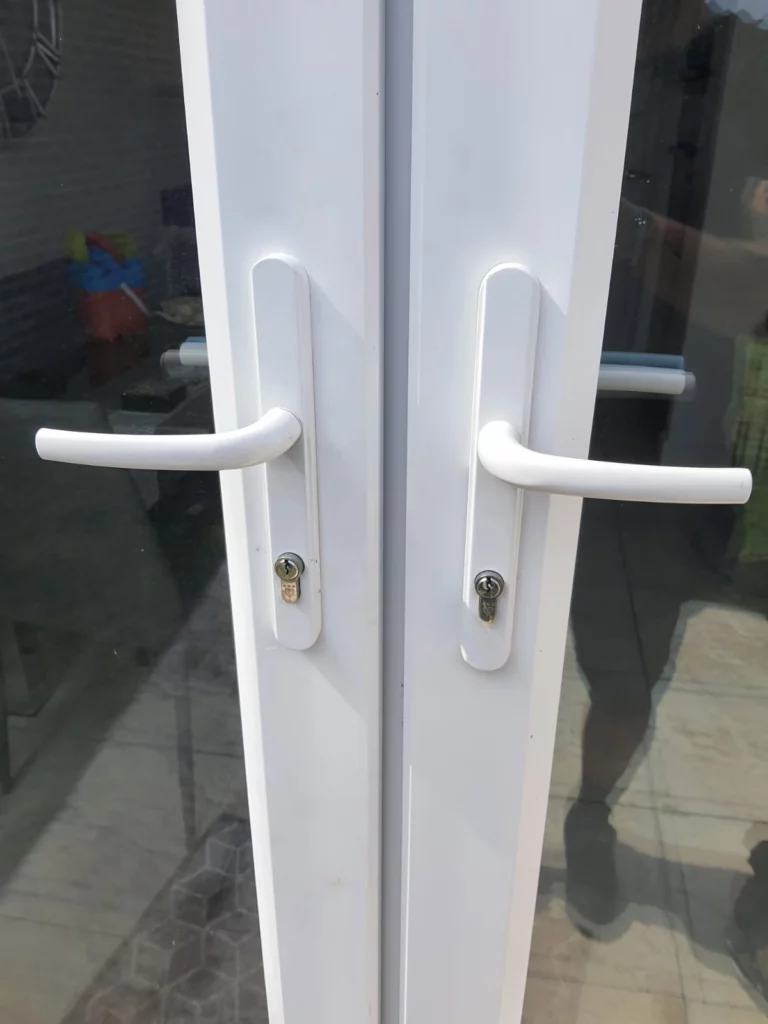
On a typical uPVC or composite French door, the handle and key work a multipoint lock on the door you use every day. The other door, called the slave or inactive leaf, is held by shoot bolts that run up into the head of the frame and down into the threshold. They are often thrown by a lever on the edge of the door (Sold Secure). On some systems the slave leaf’s bolt is also the keep for the main door’s bolt (SD Hardware). Either way, the main door locks against the slave leaf, so if the shoot bolts are not thrown, or do not reach their keeps, the main door is locking into a leaf that is not fixed to anything.
To check, open the main door, work the lever on the slave leaf, and watch the top and bottom bolts. Both should travel fully into their keeps. The bottom keep sits in the threshold and fills with grit and leaves, so clear it out.
Snappable cylinders
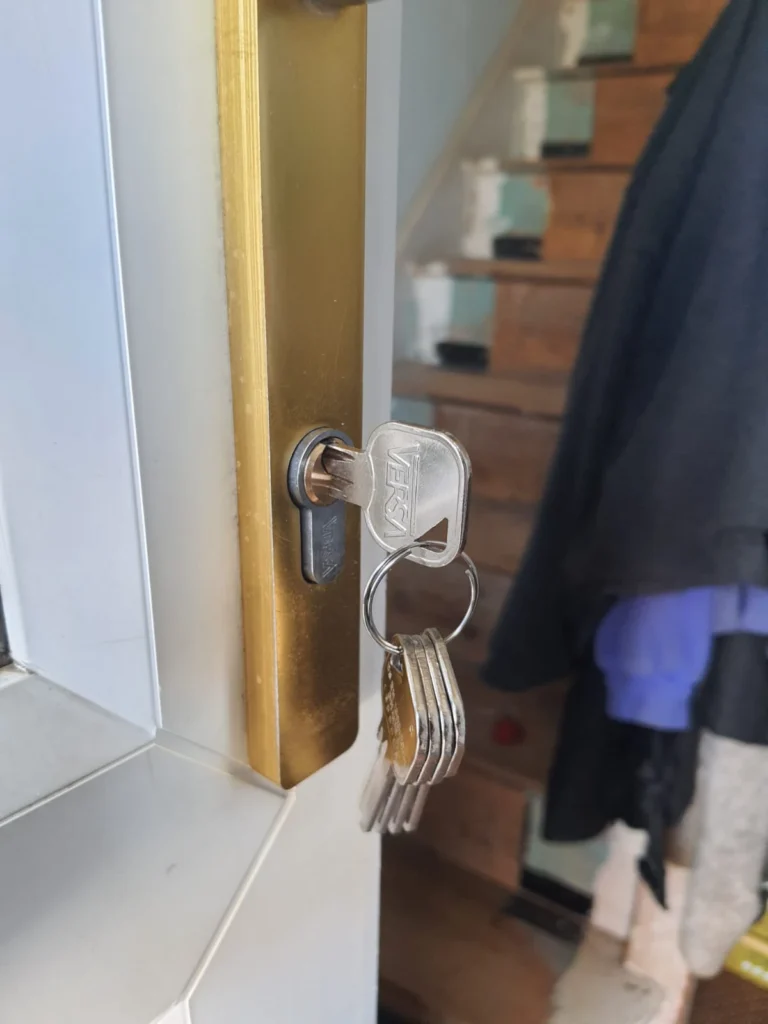
Many uPVC doors have a euro cylinder that sticks out from the handle. Police advice is to have a locksmith change a protruding lock for a shorter one that cannot be snapped off. West Yorkshire Police says the outside part of the cylinder should not protrude more than 3mm, and Essex Police recommends a 3-star cylinder that meets TS007. Our guide to insurance-approved locks, TS007 and BS3621 explains the star ratings in detail.
Wooden and outward-opening French doors
Older timber French doors may not have a multipoint lock. West Yorkshire Police advises a BS 3621 five-lever mortice sash lock just below the middle of the door, mortice rack bolts at the top and bottom of each leaf, and hinge bolts or hinge protectors on each hinge. Hinge protection matters most on outward-opening doors, where the hinges are on the outside.
The glass
Check how the glass is held in. West Yorkshire Police notes that old, split putty or bonding makes glazing easier to remove, and suggests laminated security glass to BS EN 356 P1A or higher on vulnerable doors.
Weak points and fixes by door type
| Door type | Weak point | Quick check | Fix |
|---|---|---|---|
| Sliding | Panel lifted off the track | Look for an anti-lift device or block in the top track | Anti-lift device, or a timber batten fixed in the top track |
| Sliding | Hooks not seating | Locked panel moves when pushed and pulled | Adjust rollers or keep, or repair the lock mechanism |
| Sliding | Only one locking point | Count the locks on the moving panel | Secured by Design accredited secondary patio lock |
| French (uPVC or composite) | Slave leaf shoot bolts not engaged | Top and bottom bolts fully enter their keeps | Clear keeps, adjust, or replace a worn slave mechanism |
| French (wooden) | Single latch or old lock | Look for a BS 3621 marking on the faceplate | BS 3621 mortice sash lock plus rack bolts on each leaf |
| Outward-opening | Exposed hinges | Can you see the hinge knuckles from outside? | Hinge bolts or hinge protectors |
| Any uPVC | Cylinder snapping | Cylinder sticks out more than 3mm | Correctly sized TS007 3-star cylinder |
| Any | Glazing removed | Old, split putty or bonding | Reglaze, consider laminated glass to BS EN 356 P1A |
Patio door security fixes, ranked by cost
- Free. Lock the door properly every time. Essex Police’s advice for multi-locking uPVC doors is “Lift. Lock. Remove.”: lift the handle, turn the key, take the key out. Then check the slave leaf bolts on French doors and clear the tracks and keeps.
- Low cost. Add anti-lift protection to a sliding door and a Secured by Design accredited secondary lock. A bar in the bottom track can go on the same day.
- Moderate. Replace a protruding cylinder with a correctly measured TS007 3-star cylinder, and have dropped doors, rollers and keeps adjusted so every locking point engages.
- Higher. Replace a worn multipoint mechanism, upgrade the glass, or replace the whole doorset with one tested to PAS 24.
Extra locks should never trap you inside. Secured by Design reminds householders to always give yourself a means of escape in a fire, so keep the key somewhere everyone in the house knows, away from the door itself.
Do patio doors have to meet a security standard?
For new homes in England, yes. Approved Document Q supports requirement Q1 of the Building Regulations 2010, which applies only to new dwellings. Since 1 October 2015, easily accessible doors and windows in new homes, including those created by a change of use, should be tested to PAS 24 or one of the alternative standards listed (East Suffolk Council building control). Part Q does not require you to upgrade the doors on an existing home. If you are replacing a patio door, Essex Police suggests asking about PAS 24:2022. This is general information, not legal advice, so check with your local building control team for your own project.
Your insurer may set its own lock requirements. Check your policy wording rather than assuming a patio door is covered.
When to call a locksmith
Call for help if the handle needs force to lift, the slave leaf lever is stiff, the hooks or bolts do not line up with their keeps, or the cylinder sticks out. Forcing a stiff mechanism can damage the gearbox. If the door is uPVC, our checklist for a uPVC door that won’t lock covers the common causes first.
Frequently asked questions about patio door security
Can I fit anti-lift protection to an old sliding door?
Often, yes. A timber batten fixed in the top track is one retrofit option suggested by West Yorkshire Police. The right fix depends on the door’s profile and how much clearance there is above the panel.
Do I need a British Standard lock on my patio door for insurance?
It depends on your policy. Read the security conditions in your policy schedule, or ask your insurer. Our insurance locks guide explains what the common standards mean.
Is a bar in the track enough on its own?
No. It stops the door sliding but not being lifted, and it only works while it is in place. Use it alongside anti-lift protection and a properly engaged lock.
If you are in Clacton, Colchester or the surrounding Tendring and north Essex area, Parade Locks can check your patio or French doors as part of a security survey, repair uPVC and composite door locks, and fit anti-snap cylinder upgrades. Parade Locks does not charge a call-out fee, and pensioners get 10% off. Call 07889 977737 or get in touch online. You can read more about our domestic locksmith services.